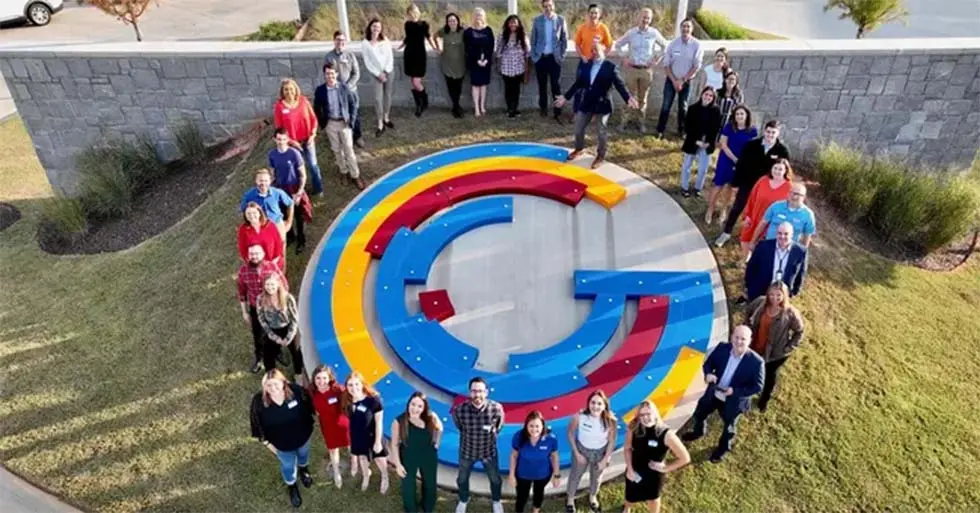
ATLANTA—As the Gray Innovation Lab celebrates its first anniversary this week, Gray Media’s push to accelerate innovation at the company has already produced some notable advances in the adoption of AI solutions by newsrooms, ad sales and engineering staff.
“The goal [for the Gray Innovation Lab] was really to take a wholesale, fresh look at everything we are doing in a multidisciplinary way,” explained Claire Ferguson, vice president, assistant general counsel and senior technology counsel at Gray Media. “The idea was to take a look at what we are doing, ask why we are doing things the way we do them and think about what we can do to make things better.”
One major focus since the launch of the Lab a week before Christmas in 2024 has been AI solutions. Ferguson estimates that they spent about 80% of their time in the first 10 months developing what they call the “ask grAI” platform. It went live in October.
“It is the biggest thing to come out of our work so far,” Ferguson said. “We have about 10,000 employees and all of them now have a login because we felt it needed to be a very democratic product.”

The "ask grAI" solution leverages LLMs or large language models, but was developed and customized to both protect Gray’s data and take advantage of Gray’s internal data to train the platform.
“It is a product that uses standard LLMs as sort of the meat of the hamburger,” Ferguson said. “But below it, we have our own company data, our own company training materials and any number of proprietary and specialized data that we want it to leverage as well. There's robust data security and protection so that there's no data leakage, as there would be if you were simply using ChatGPT. You can use the GPT LLM within ask grAI, but it will add a filter [to reflect] the Gray way that protects your data and gives you a response that we have spent 10 months really carefully training and honing to help our teams.”
`A LOVING EDITOR'
The launch makes Gray a notable example of how station groups are trying to use AI to both create new business opportunities and strengthen their traditional operations.
Gray’s approach to applying AI tools is particularly evident in the newsroom, which is where the tool has been the most heavily adopted.
Here, one major goal has been to automate menial tasks so that journalists have more time to report stories and interact with the local community. “It can do things like give SEO guidance, things that journalists didn’t claw their way into journalism school to spend their time doing,” Ferguson said. “If we can push some of that work to AI, it will let our journalists get back out into our communities.”
“By allowing our journalists to get back to doing what they want to be doing, we think there is a real opportunity in terms of improving the volume and quality of stories,” she added.
Other notable examples of its use are in reversioning stories for different platforms and in editing.
Its editing capabilities include tools for fixing grammar and adhering to AP Style guidelines, as well as providing feedback for stories.
“It does not rewrite stories,” she stressed. “It might simply say, 'have you considered asking the mayor for a comment on this?’ Or it might say, `the story seems one-sided, have you considered alternative views?’ It acts as a loving editor.”
“It can also assist our news teams with versioning,” she added. “So if you've got an on air script and you're looking to turn it to a digital story, it will assist in changing all the capital letters into standard use.”
Ferguson stressed that they’ve put safeguards in place to ensure that journalists oversee the whole process: “Our journalists are trained to understand that even with light editing touches, the finished product has to be the responsibility of the journalist who is using the tool. It has to be carefully reviewed by the journalist to ensure that there were no changes made to that digital story that they haven’t approved.”
HYPER-PERSONALIZED STREAMING
Looking forward, the use of AI to reversion stories for different platforms is likely to become even more important, as Gray ramps up its digital and streaming efforts.
In early 2026, Gray’s plans to launch a hyper-personalized video streaming platform, for example. The platform is the result of an wide-ranging streaming deal that Gray inked for a full end-to-end streaming solution on Google Cloud powered by Quickplay.
The new platform aims to redefine the streaming experience by combining the power of Google Cloud's AI infrastructure with Quickplay’s flexible, cloud-native platform to deliver deeply personalized viewing experiences, the companies reported in an August 2025 announcemen.
“That partnership goes far beyond the nuts and bolts of distribution and OTT delivery,” Ferguson said. “It will offer some really interesting, consumer friendly and facing capabilities, like using AI in a limited capacity to create YouTube shorts, or, convert video to vertical. Those are important efforts for our distribution strategy going forward to reach larger audiences on more platforms.”
The ability of AI to search through large document dumps and collect data has also been adopted by Gray’s investigative journalists and units. In one case, it is being used to collect data on local arrests, which in the future could help identify trends in the criminal justice system. In other cases, it opens up opportunities to develop stories around large document releases or data sets that might otherwise be too time-consuming to analyze and report.

“I do think it can reignite a spark in folks who feel as though they’re spending too much time on things like SEO,” she said. “We train our people not to rely on it exclusively and write stories based on AI summaries. But it can certainly help them dig into a trend that might not have been covered in the past.”
AI TRAFFICKING
Another major area of focus for AI solutions has been in advertising sales and trafficking. “We think of our platforms as a way to reduce friction,” Ferguson.
In terms of ads sales, many station groups like Gray have already been using AI to create ads and creative for smaller advertisers who couldn’t create their own 30 second or 60 second spots. “We think there is a massive upside for that,” she said.
But can also have an important impact on ad operations. Ferguson noted that “we’re still working through this application but, preemption trackers and tracking which sports ads are approved in different leagues can free up a lot of time.”
Engineering, “is another area where we have a lot of really excited folks,” she added. “We think there is a big opportunity here in terms of uploading manuals and leveraging the information we have at each of our 114 different television stations. We want to see how we can utilize AI to better know that information and leverage it.”
And, while AI and automation is often discussed as a way to reduce staffing levels, Ferguson stresses it can also be a way to avoid burnout by journalists and other employees who are tasked with feeding content to multiple platforms.
“Burnout in newsrooms is an incredibly real thing and something we’re hyper focused on,” she said. “Our ask grAI is very much intended to be a response to that. People don’t burn out from being in their communities and telling stories that are meaningful to them.”

