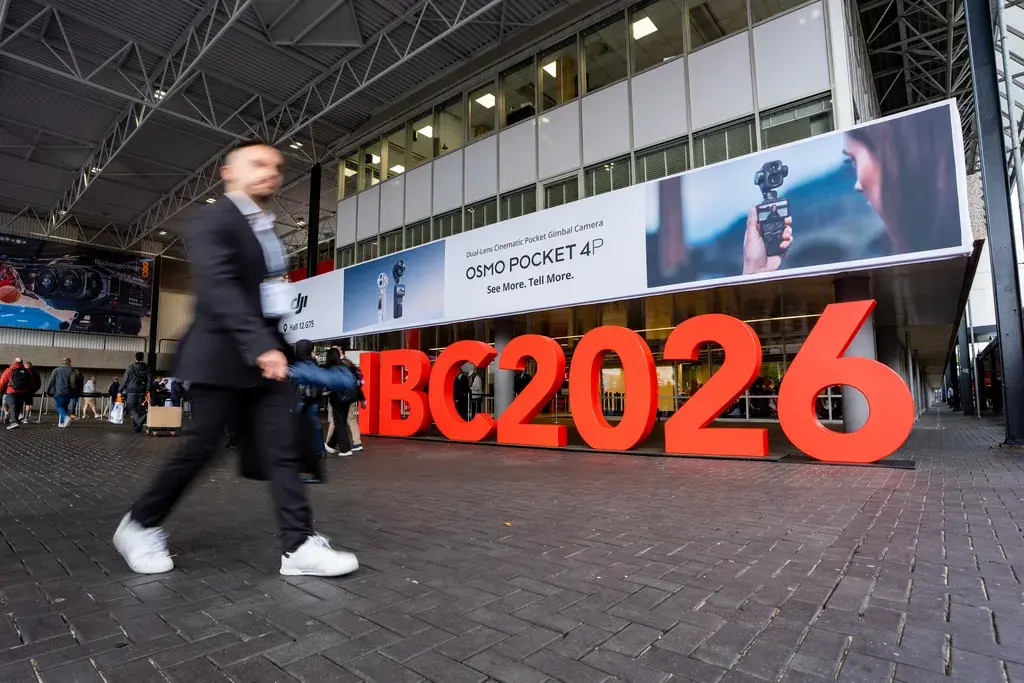
As a veteran of 25-plus IBC Shows over the past nearly 30 years, I can attest that navigating the annual gathering has its own particular quirks that distinguish it from the NAB Show, particularly the tone of the locale. Apart from the fact that Amsterdam is the “wet and humid” show and NAB is the “dry” show (but only when talking about the climate), IBC also represents a more relaxed tone that reflects the nature of the ancient city itself.
Nevertheless, most of the themes were similar, and before we set our sights on the next gathering (NAB Show New York), I wanted to share some of my thoughts around the central themes:
AI: IBC reported 41,225 attendees for the show, which ran Sept. 11-14 at the RAI Amsterdam, down 6% from 2025. Although consolidation, particularly among U.S. broadcasters, is often cited as one of the main reasons for the decline, I also think it represents a cooling off from the past three or four years, when interest was higher after COVID. (That’s not to mention that the number of attendees from the U.S. has declined since trade shows resumed in 2022.)
But I also think artificial intelligence is playing a role, as more processes become automated. I was reminded of this after hearing Grass Valley Chief Technology Officer Ian Fletcher’s rule that “complexity doesn’t go away, it just moves around.” As the process of media management, production and distribution becomes more automated and software-based, more people are moved out of the media production chain.
Seeing a software demo on the show floor can certainly have more impact than over Zoom, but is it still worth the cost of travel?
This is an ongoing issue that won’t be resolved by the oft-repeated trope that those same people who were doing rote tasks are simply being moved to other areas where they can “focus on other more important work.” Attrition is real and growing.
Collaboration: In our industry, companies have a long history of partnering with competitors, but that seems to be increasing—and this is more of a reflection of the increasing focus on software.
Nowhere was this better illustrated than by the growing influence and impact of MXL (Media eXchange Layer), a critical component of the EBU’s Dynamic Media Facility initiative. Tech demos showcasing partnerships between Grass Valley and Lawo, Matrox and EVS, as well as multivendor demonstrations at the Techex, Qvest and AWS stands, just to name a few, demonstrated how quickly MXL is moving beyond the proof-of-concept stage toward real-world deployment.
The EBU-led MXL initiative also received significant recognition at IBC, winning an IBC 2026 Innovation Award in the Content Creation category. The growing number of vendors incorporating MXL into commercial products and demonstrations suggests the technology is increasingly becoming part of the broader software-defined media ecosystem.
Cybersecurity: Alarmed over recent news of disruptions created by “rogue” AI agents, the security of media production systems was also top of mind for many attendees. As more media and media processing moves into the cloud, concern over potential vulnerabilities increases. This has prompted more production to become hybrid-based, with certain content and processes stored both in the cloud and on-prem.
It has also led to more interest in “MCP,” or Model Context Protocol, a framework that allows customers to establish guardrails to limit information accessible to AI agents.
Tariffs: The “T-word” was back, having been overshadowed by AI and the memory and chip shortages that were the talk of earlier shows. With many of the media tech industry’s largest companies based in Canada, President Donald Trump’s recent imposition of a 50% duty on targeted goods has forced some vendors to raise prices. And although some goods are exempt and vendors are attempting to absorb costs, the tariffs—along with the continued pressure on memory and chip availability worldwide—are cause for concern. However, the increased influence of software-defined production is helping to ameliorate the impact.
I’ll share more of my thoughts about my conversations with IBC exhibitors in the October issue of TV Tech.

