
PORTSMOUTH, N.H.—New research indicates that in the streaming subscription businesses, not all subscribers are equally valuable. According to Hub Entertainment Research’s “Decoding the Default” 2026 study, the more engaged users are, the more likely they are to stay and the less likely they are to churn and drop subscriptions.
This has important implications for the problem of subscribers churning in and out of subscriptions, which increases marketing and retention costs.
The HUB researchers found that the clearest signal of that engagement is whether a viewer considers a service their default, which is to say it is the service they turn on first when they want to watch something.
Being the default service not only drives usage. The new Hub data indicates that across paid streaming, free ad-supported services, and live TV, a viewers' default services are far less likely to be canceled, often remain in households for years, and are the ones consumers are most likely to personalize and make their own.
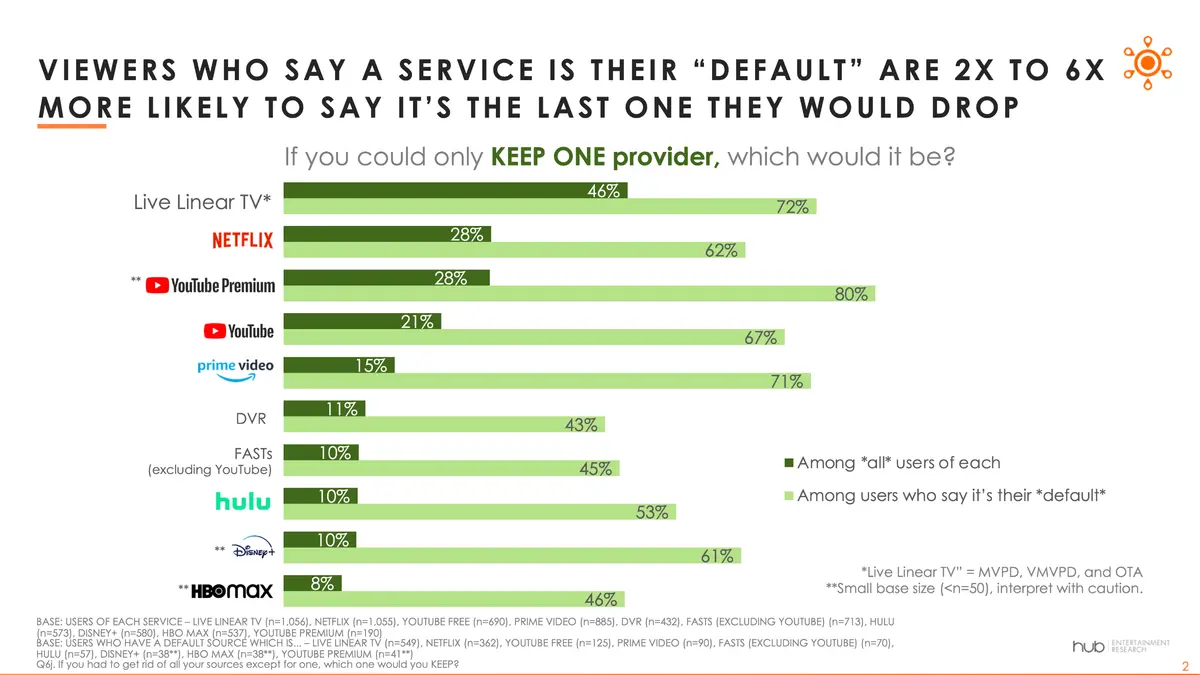
More specifically the survey found that viewers’ default source is the last one to get cut. When viewers are forced to imagine keeping only one service, being someone’s default source is worth two to six times as much loyalty as simply being used.
Among all Netflix users, 28% say they’d keep it if they could only keep one service. Among users who call Netflix their default, that jumps to 62%. The gap is even wider for Disney+: 10% of all users would keep it alone, versus 61% of users for whom it’s the default — more than six times as loyal.
“This data illustrates why streaming’s metric of success is shifting from subscriber numbers to engagement,” said Jon Giegengack, principal at Hub Entertainment Research and one of the study authors. “It also suggests the benefits that might come from combining Fox and Roku, and partnerships like Peacock and YouTube Premium, or Netflix and TF1 in Europe. These all create combined services that have more than one ‘starting point’ than either platform does by itself. And if you give viewers a compelling reason to start with your service, they will use your service more and stick around longer.”
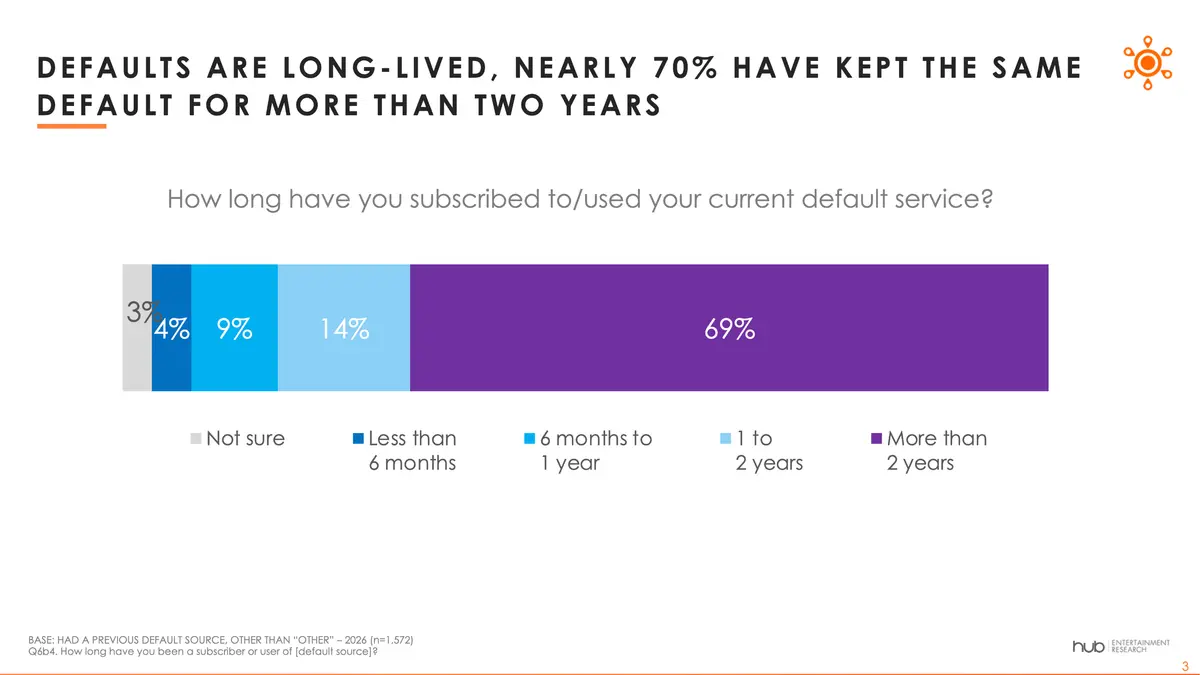
Default services are also long-lived: nearly 70% have kept the same one for more than two years, Hub reported.
The no-contract streaming era has made viewers notoriously fickle when it comes to subscription-hopping. But once a service becomes “home base” for TV, that relationship is much more stable. More than two thirds (69%) say they have subscribed to their current default source for more than two years.
The survey also found that viewers invest time to make their default “their own," which in turn makes them more sticky.
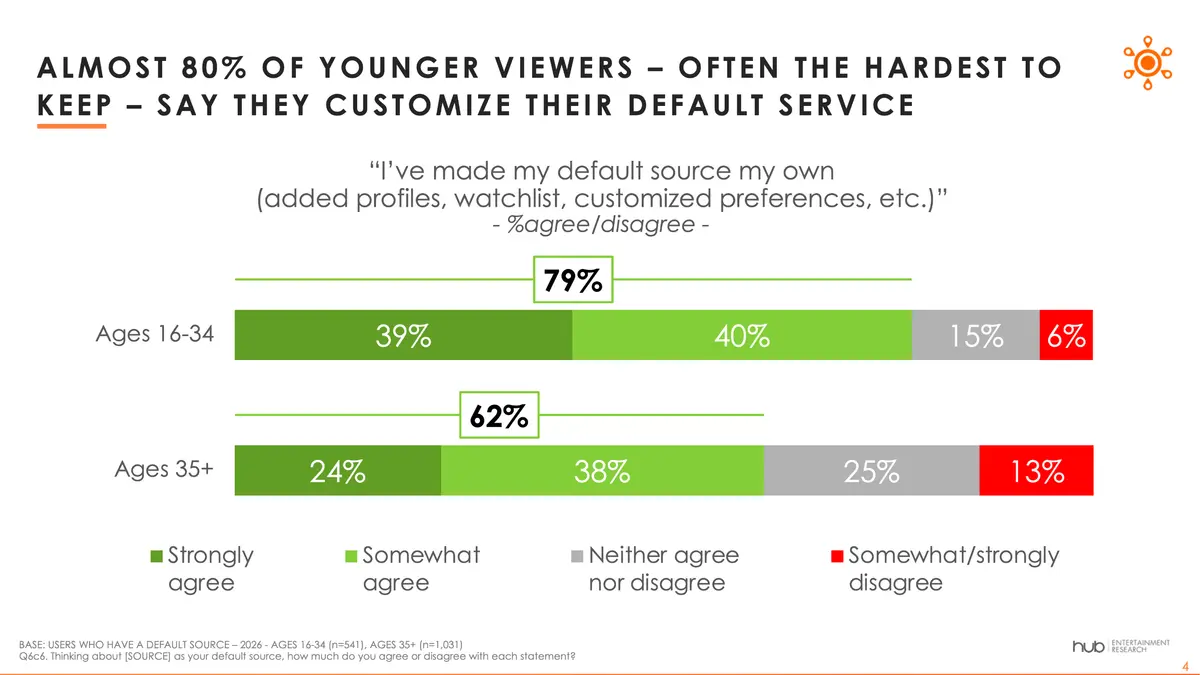
Most viewers say they’ve spent time making their default service “their own,” by creating profiles, building watchlists, and customizing the app settings. This is especially prevalent among younger viewers (a segment particularly hard to retain).
More specifically, two-thirds (68%) of viewers overall agree they’ve made their default source “their own” through a profile, watchlist, or saved preferences. Among viewers under age 35, that rises to 79%, compared with 62% of viewers 35 and older.
These findings come from Hub Entertainment Research’s “Decoding the Default” 2026 study, based on a survey of 1,600 U.S. TV viewers ages 16-74 with broadband access, U.S. census balanced, conducted in August 2026. It is part of Hub’s ongoing series of syndicated Hub Reports.

