Latest articles by MICHAEL ROBIN

Digital video is a method of representing the infinite variations of video signal levels inside a specified limit (e.g. 0mV to 700mV) as a limited number
Resolution Many of the aspects of today's legacy television standards (SDTV) were developed through experiments carried out in the 1930s. They reflect
MPEG editing North American (FCC) and inter national (ITU) spectrum management concerns resulted in the analog television on-air channel allocations and
Audio synchronization Analog audio is difficult to handle. There are frequency response problems, distortion problems (harmonic and intermodulation),


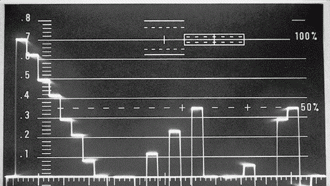
An ideal situation for large installations would be to incorporate EDH processors at every routing switcher input and output.

Michael Robin shows readers how analog noise is detrimental to the encoding results and what steps they can take to remove the noise and maximize the signal quality

All systems have noise and analog noise. In this month's Transition to Digital, Michael Robin helps readers understand the difference and where to look for the causes

Michael Robin continues with Part II of his series on noise. This month he looks at digital noise, sources and remedies
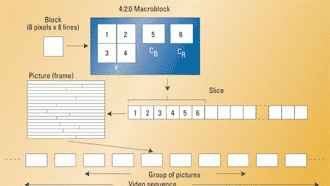
The goal of digital video compression is to reduce bit rate by identifying and removing redundancies, while preserving picture quality.
The original development of analog television was based on the concept of direct, real-time, on-air transmission of live programs and, occasionally, films.
The common carriers play an important role in the delivery of television programs to private homes

Given history, the development of accepted standards for digital video could be a challenge. The author takes a look at standards bodies and the industry’s past standards
In the 1980s, many interested parties began developing concepts of advanced television, or HDTV, geared at reproducing superior-quality 16:9 aspect ratio
The world around us is analog. Our perception mechanism is also analog. Standard audio transducers, such as the microphone and the loudspeaker, are analog

Combining multiple audio channels into a single stream is called multiplexing. It’s complex and requires careful planning. However, there are many solutions available, which the author reviews

The advent of digital processing of video signals has introduced a new twist in the concept of picture resolution. This article will analyze some of the implications.

