Latest articles by JOHN LUFF

Technology in Transition: Media asset management systems
This issue we complete a four-part series on station automation. We have looked at station automation, newsroom automation, data archive systems and, in this issue, media asset management systems.
Technology in Transition: Data archive systems
In the second installment of four related to automation and asset management, this month we consider data archive systems.

The right connections
Wire, cable, and fiber hold your facility together; make sure they're properly installed

A switcher's life cycle
This month, let's look at production switchers from the standpoint of product life cycles. Every manufacturer looks at the four stages of product life
Video servers
It is no surprise that IT technology is increasingly penetrating broadcast TV operations. There are many reasons for this today, but when early broadcast

Master control systems
Master control has an auspicious sound to it. When you hear the words master control, you think of a technology that keeps everything running perfect

Camera imaging
Capturing images has always started at the most elemental level in fact, all the way to elemental particles. For nearly 200 years, chemical photography
Technology in Transition: Video storage
Television is a medium of considerable immediacy, but it is steeped in technology that often shapes how the media is used.
BIG screen values come to the small screen
HD broadcasts over DTV channels hold the promise of delivering vastly improved pictures and sound, along with data that can augment the linear video medium in an age of hypermedia.
Production switchers
Digital production switchers have been on the market for many years now.
Routing switchers: POTS, routers and switches
As the number of inputs and outputs grows the total count of crosspoints grows. Though complexity is high with virtual crosspoints, the relative cost

Audio consoles
Always include extra inputs. Eventually new consoles will be old and dead inputs will happen. Just wait till the news anchor hears his own voice four
Video tape recorders
Videotape still stores the intellectual assets of several generations of television production. Commercial videotape recording began in the late 1950s.
HD conversion products: The big picture on small pixels
The picture is not improved by upconverting a 525 signal to HDTV for DTV transmission. For many years consultants, equipment designers, production professionals
Virtual sets: Imagining we were there
Controlling reality is always expensive, and creating illusions is sometimes nearly as expensive. Entire motion pictures are being created in computers,
Editing systems
With disk space as cheap as paperclips, load time is considerably less of an issue. It is clear that we have indeed come a long way from razor blades
Video storage and networking for centralcasting
The motivation to consider centralized operations is simple. Costs are rising, ad sales are slumping, and cash flow from operations is hurting.
Technology in Transition: Newsroom automation systems
When college students attend classes in broadcast journalism today they are pretty unlikely to be exposed to manual typewriters, paper roll teleprompters and news distributed on teletype machines.
Automation software
For the next four months this column will focus on four interrelated and interdependent areas of television technology: automation software, data archive
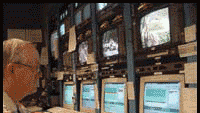
Centralcasting solutions
An automation system that removes as much human intervention as possible is key.


